
Finding Clients
Your Clients Know You're Great. Strangers Have No Idea.
November 4, 2026 · Bradley Jacobs
What should you be known for?
Get your positioning, content pillars, and writing profile from your LinkedIn profile.
Free. No credit card required.
Your clients trust your judgment. They've seen you solve problems they couldn't solve on their own. You've helped them see around corners. You know that when you get in with a client, you're going to deliver.
The problem is everyone else. Someone who's never worked with you has zero evidence of any of that. They don't know what you can do. They don't know what a difference you could make. And if your public-facing presence doesn't show them, the gap between what you're worth and what strangers assume you're worth stays wide open.
In this issue:
- Why expertise feels invisible to the person who has it
- How Conrad went from "I run a VA agency" to something actually compelling
- Why sharing 1% of what you know puts you ahead of 99% of your peers
- What a 700K-impression post about Uber taught me about inbound leads
The Curse of Knowing Too Much
Here's what happens when you've been doing something for years. The things you know best start to feel obvious. They feel like common sense. So you assume they're not worth sharing.
A digital marketer who tracks CAC and LTV by source using UTM parameters knows that's table stakes. Every marketer knows it. Why would they post about something so basic?
Because millions of founders have no idea how to do it. Or even that they should.
The knowledge gap between you and your potential client is enormous. But because you're inside your own expertise every day, you can't see the gap anymore. You've forgotten what it felt like not to know. And so you stay quiet, assuming that what you know isn't interesting enough, isn't advanced enough, isn't worth putting out there.
That silence is costing you.
What Vague Positioning Actually Sounds Like
I worked with a customer named Conrad. Conrad runs a VA agency. He places virtual assistants inside companies. And when he first described what he did, that's basically all it sounded like: I run a VA agency.
There are thousands of those. Maybe millions.
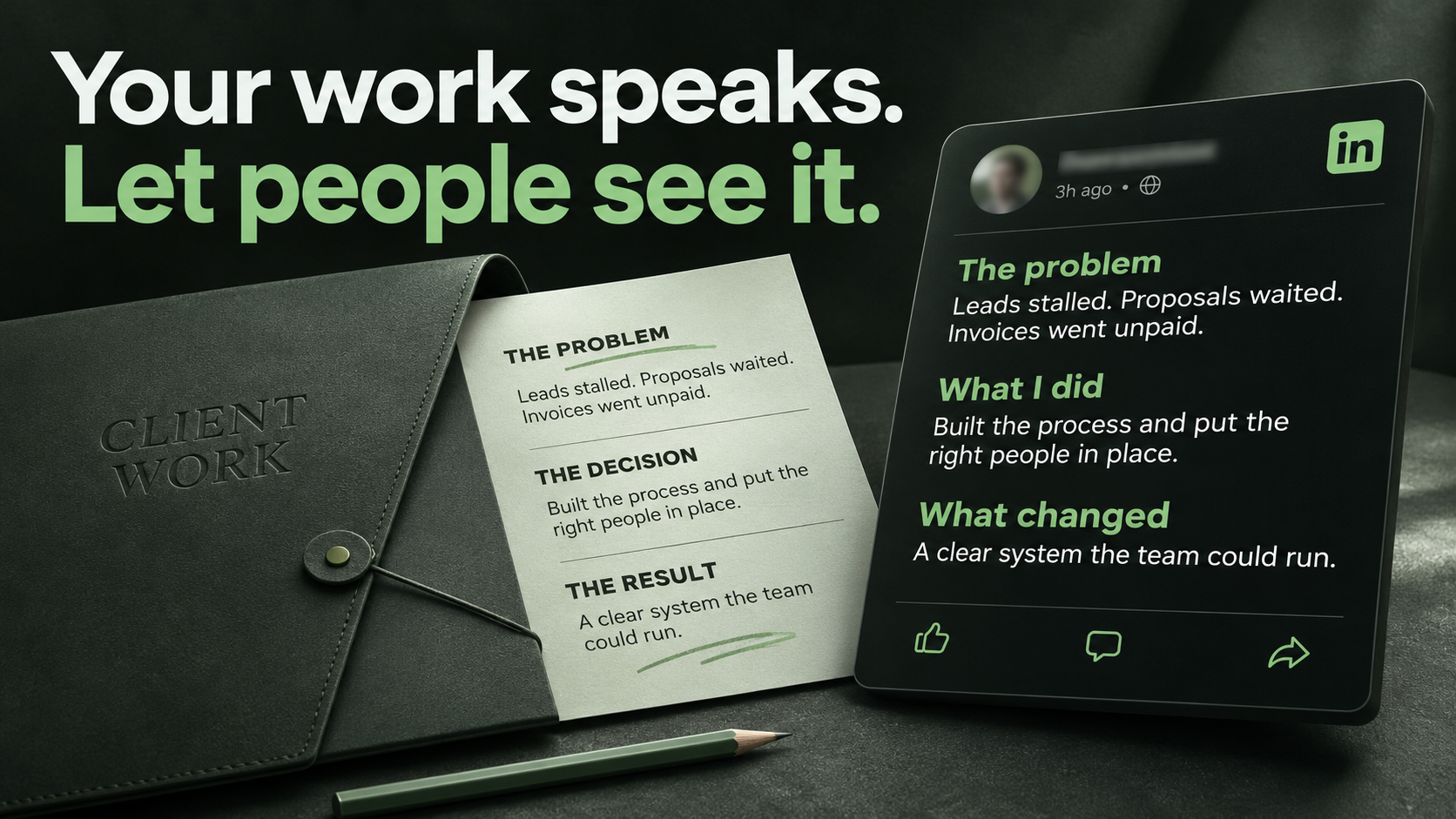
So I pushed him. I asked him to tell me about actual work he'd done. He described a client who needed help following up with leads, getting proposals sent, and collecting invoices. What Conrad actually did was scope out what needed to happen, design the systems to make it work, and then bring in the right people to run those systems at a cost that made sense for the business.
That's a completely different thing than placing a VA.
When you can walk into a company, identify the bottleneck to growth, build the process to fix it, and hire the talent to run it, that's a specific, valuable, clearly defined service. It's not "I help you find efficiencies." It's not "I help you grow your business." Those phrases tell me nothing about what you actually do.
The version that works is specific enough that someone reads it and thinks: that's exactly my problem. Or: that's not my problem at all. Both outcomes are useful. Vague positioning produces neither.
The goal isn't to appeal to everyone. It's to make the right person think, within ten seconds of landing on your LinkedIn or website, that getting on a call with you is worth their time. Because that's all B2B sales really is. Nobody is writing a $20k or $50k check without talking to you first. You're just trying to get on calls. Everything else is about building enough credibility that a stranger wants to book one.
One in a Hundred
Here's the number that keeps coming up when I look at this: one in a hundred.
One in a hundred fractional CMOs is actually sharing their expertise on LinkedIn. One in a hundred consultants in a given field is writing about what they've learned, what they've seen, what worked and what didn't. One percent.
That means if you start sharing what you know, you are immediately ahead of 99 out of 100 people in your field. Not because you're smarter. Not because you're a better writer. Just because you showed up.
I hear the objections. LinkedIn feels cringy. Self-promotion feels weird. What if someone judges you? What if the post is bad? I get why those fears feel real. But they're also excuses. And I say that with zero judgment because I've made the same ones.
Here's the reframe that helped me: if you can add $500k to a client's business and they never get the chance to work with you because they didn't know you existed, they lose. They're the ones who miss out. Keeping your expertise private isn't humility. It's a disservice to the people you could actually help.
What 700K Impressions and 22 Leads Taught Me
A few years ago I was doing go-to-market consulting. I wrote a post about something I'd lived through at Uber: the day in April 2014 when Uber and Lyft both launched in Raleigh, North Carolina on the same day. Same product. Same price point. Six months later, Uber had 90% market share in the Raleigh, Durham, Chapel Hill triangle.
I wrote about why. Five reasons, from my own first-person experience on the ground. What we did, what Lyft did, what the data showed, and what I believed made the difference. It was detailed. It had numbers. There was no fluff in it.
Nowhere in that post did I mention my consulting business. I didn't say I was open for work. I didn't have a call to action. I didn't even have a CTA on my LinkedIn profile at the time.
The post hit 700K impressions. And 22 people DMed me asking for help with their go-to-market. Not because I pitched them. Because I told them something true and specific and useful, and they connected the dots themselves.
That's how credibility works. You don't declare it. You demonstrate it, and people draw their own conclusions.
Just Share What Happened
The practical version of all this is simpler than most people expect.
Pick a specific situation. A company you worked with, a problem you faced, a decision that had real stakes. It doesn't matter whether it was a success or a failure or something messier in between. Tell what happened. Tell what you learned. That's it.
You don't need a perfect hook. You don't need a content strategy. You don't need to engineer virality. You need to be specific enough that a stranger reading it starts to understand what you actually know and how you think.
The story does the convincing. You don't have to.
This week, find one situation from your work history that taught you something real. Write what happened in plain language. Post it. That single post will tell a stranger more about your value than your job title ever could.