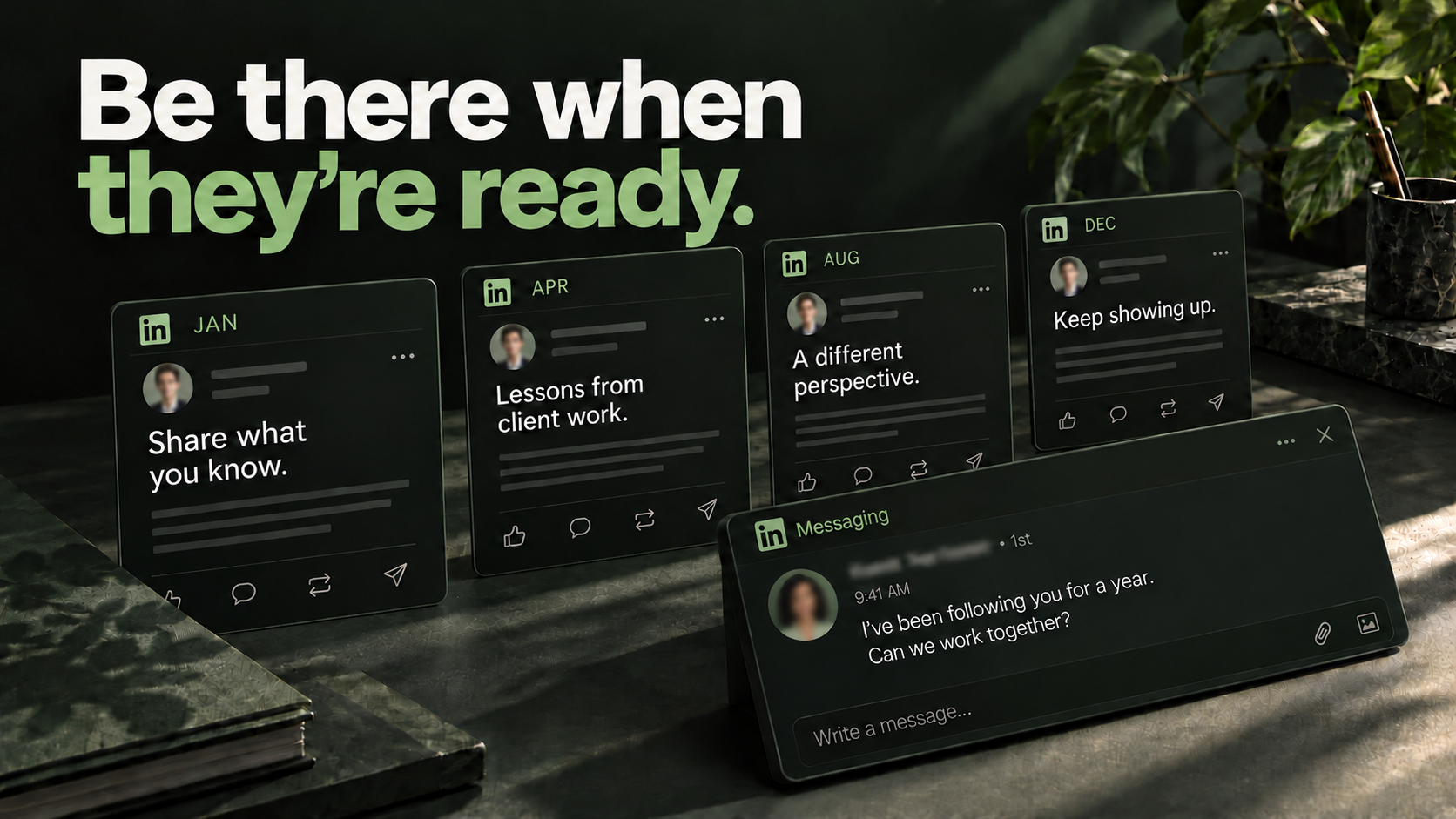
How to Write LinkedIn Content Your Ideal Customer Cares About
October 28, 2026 · Bradley Jacobs

Get your free LinkedIn positioning in 60 seconds — drop your handle:
To write LinkedIn content your ideal customer cares about, start with a specific problem or decision they face. Use the language they use in conversations, add your perspective and reasoning, and explain when your advice applies. Then review responses from relevant readers to see what resonates.
Most business owners write LinkedIn content about what they enjoy discussing. Not what their ideal customer has a reason to read. Those are different things, and the gap between them helps explain why a post can get decent impressions but little response from the people you intended to reach.
The question worth asking before every post is simple: will my ideal customer actually care about this? Not your peers. Not people in your industry who already know what you know. The specific person you want to hire you.
In this article:
- How to define your ideal customer in terms that actually shape your content
- The difference between a topic you like and one your reader needs
- How to mine real customer language and turn it into posts
- How Mylance connects your positioning to topic selection so you're not guessing
How Do You Define the Reader for a LinkedIn Post?
Most people skip this step or do it in a vague way. "My ideal customer is a mid-market B2B company." That's not a reader. That's a category.
A reader has responsibilities. They have a situation. They have problems that show up on a Tuesday afternoon when something breaks or a decision lands on their desk that they're not sure how to make. That's who you're writing for.
So define them that way. What are they responsible for? What does their week look like? What decisions are they facing right now that they haven't fully resolved? What's the thing they keep running into that nobody has given them a clean answer on?
When you define your ideal customer at that level of specificity, the content question changes. It stops being "what should I post about?" and becomes "what does this person need to think through, and do I have something real to say about it?"
That's a much easier question to answer. And the posts that come out of it read completely differently.
Are You Writing for Your Peers or Your Ideal Customer?
Here's where most LinkedIn content goes sideways. The business owner is genuinely expert at something. They find certain topics interesting. So they write about those topics, in the language they use with colleagues, at the depth that makes sense to someone who already lives inside the problem.
That's writing for industry peers. It's not writing for someone who needs your expertise.
The same topic lands completely differently depending on who's reading it. Take something like operational efficiency. An agency owner and an in-house marketing leader both care about it, but for different reasons, at different stages, with different constraints. A post written for one of them will feel off to the other, not because the content is wrong, but because the framing doesn't match their situation.
Expertise without jargon is the other piece. The reader doesn't need to understand your internal terminology to get value from what you know. In fact, when you write in the language of your industry instead of the language of your customer's problem, you're signaling that you're writing for people like you, not for them.
A clear point of view helps here. Not just what you believe, but why you believe it, and when your advice actually applies. That specificity is what makes a post feel like it was written for the reader's situation, not broadcast at the general public.
How Do You Turn Customer Questions Into LinkedIn Posts?
The fastest way to write content your ideal customer cares about is to stop inventing topics and start collecting them.
Customer conversations. Onboarding questions. Objections. Emails. Feedback after a project wraps. That's where your ideal customer is already telling you what they're thinking about, in their own words.
Take three real questions from those conversations. Keep the wording close to how the customer actually said it. That phrasing matters because it's the phrasing your next customer will recognize when they see it in a post.
Turn each question into a post. Not a FAQ answer. A post with your perspective on why the question is harder than it looks, what most people get wrong, what you'd actually recommend and why. That's the structure: their question, your point of view, the reasoning behind it.
An illustrative example: say your ideal customer is a logistics broker who keeps asking: "How do I grow revenue without just adding more headcount?" That's a real question with real stakes. A post that opens with that tension, explains why the default answer (hire more people) creates a ceiling, and then shares what you've seen work instead, that gives the right person a reason to stop and read. Not because it's clever. Because it's about them.
That's what relevance actually means. Not broad appeal. Specific recognition.
How Mylance Connects Your Positioning to Post Ideas
The problem with doing this manually every week is that it's a lot of recurring mental work. You have to remember who your customer is, what they care about, what you've already covered, and which angle is actually going to land. Doing that work inconsistently can make it harder to build a recognizable body of content for the reader you want to reach.
Mylance is built to carry that context for you. When you set up your account, you put in your positioning and your audience information, who you serve, what problems you solve, what you want to be known for. Mylance uses that to recommend post ideas, not generic prompts, but topics drawn from your actual audience and expertise.
The categories matter. Content that adds value, educates, inspires, or validates you as the right person for a specific problem. Those aren't just content types. They're the reasons a reader stops, reads, and starts to think "this person gets what I'm dealing with."
To assess resonance, look beyond impressions. Relevant comments are one useful signal. The kind of comments where someone says "this is exactly what I've been wrestling with" or asks a follow-up that tells you they're in the situation you described. That's signal. Impressions tell you the algorithm showed the post to someone. Comments from the right people can show that the post landed. Direct feedback and conversations matter too; some people read without commenting.
Patterns across posts tell you even more. When the same type of reader keeps engaging with the same type of content, that's your signal to go deeper there, not to pivot to whatever got the most likes last week.
Try This With One Customer Question
Pick one real question a customer has asked you in the last 30 days. Write it down in their words, not yours. Then write a post that takes a clear position on why that question is harder than it looks and what you'd actually do about it. Don't smooth out the edges. Keep the specificity that makes it recognizable to the person who asked it.
That's the whole method. One real question, one real point of view, one post that the right reader will feel was written directly for them.
Frequently Asked Questions
How do I know whether a LinkedIn post resonates with my ideal customer?
Look for responses that show relevant people recognize the problem: specific comments, follow-up questions, direct feedback, and patterns across several posts. Impressions describe reach but cannot by themselves establish relevance.
What if my ideal customers use different language than I do?
Start with the wording they use in real questions, then explain your answer in plain language. Introduce technical terms only where they help the reader understand or make a decision.
Published October 28, 2026.