Your Next Client Is Watching You. They’re Just Not Ready Yet.
October 22, 2026 · Bradley Jacobs
Get your free LinkedIn positioning in 60 seconds — drop your handle:
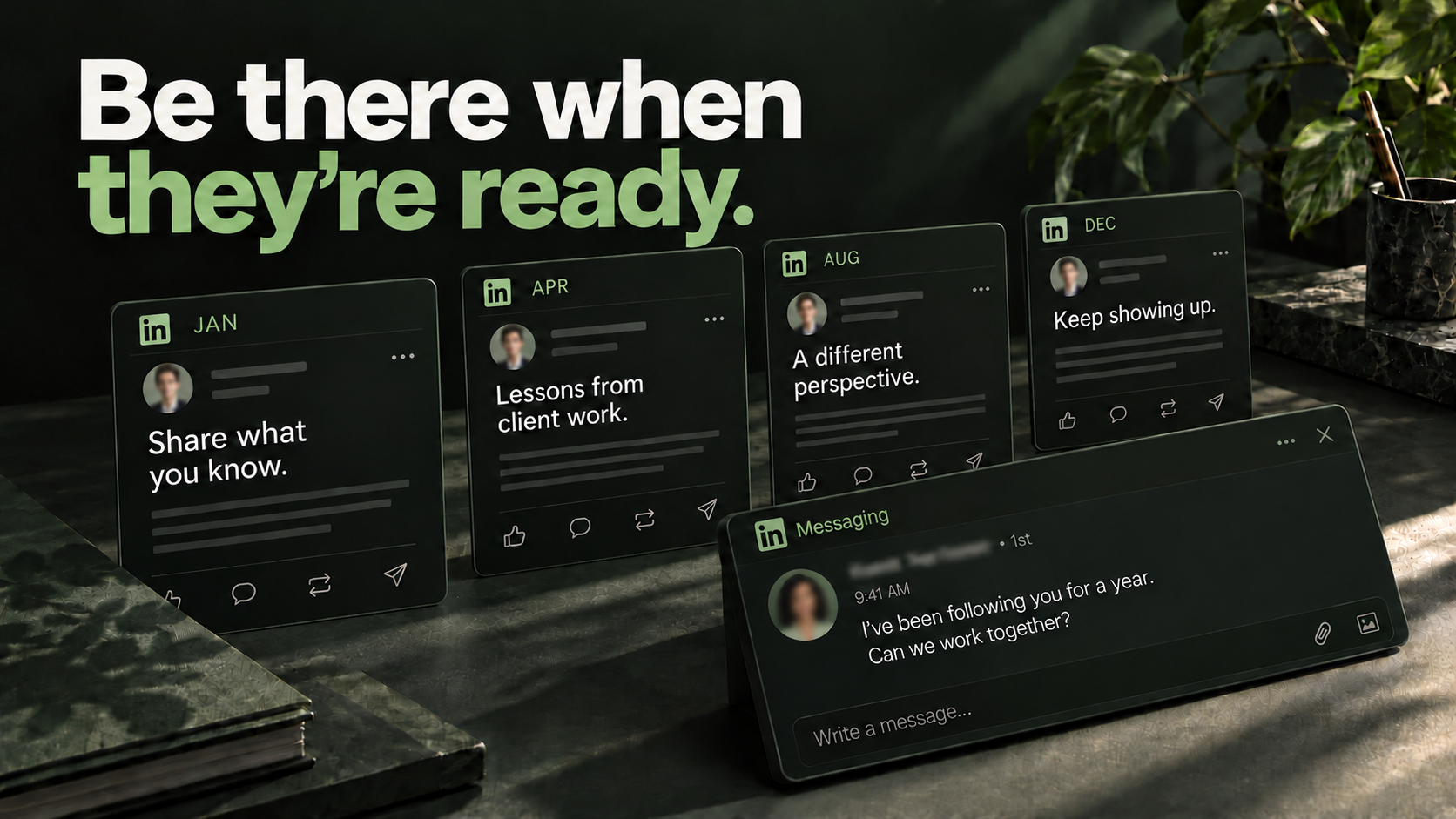
A prospect recently shared with me they'd been following my content for over a year and loved what I was putting out there. But I hadn't seen them one time. They never liked a post. Never commented. Never sent a message. And then out of nowhere they reached out, told me my content had changed how they thought about their business, and asked if we could work together.
I've had that happen more times than I can count. Twelve months of silence, then a conversation that turns into a customer.
In this issue:
- Why buyers go quiet for months and then move fast
- The only strategy that works when you can't predict the moment
- Why repetition isn't the problem you think it is
- The three-part system that compounds over time
The Moment That Changes Everything
Here's what I've learned about who actually buys from me. There's a version of the conversation where someone says, "That's interesting, I'll think about it." And there's a version where they say, "I need this, when can we start?"
The difference is almost never about the product. It's about what's happening in their life.
Maybe they got laid off. Maybe they lost their biggest client. Something shifted, suddenly and without warning, and the thing they'd been putting off became urgent. For my customers, it's usually a moment where they realize they can no longer keep avoiding LinkedIn. They know it works. They've watched it work for others. They just don't know what to say, and they're not confident that what they say will matter.
That moment is the trigger. And here's the problem: I can't predict when it happens for any individual person. Some businesses can. If you sell business insurance and you can find out the day someone files for an LLC, you can get in front of them at exactly the right time. Most of us don't have that. We're not going to know when the layoff happens or when the client walks.
So the only real strategy is to be in front of people so consistently that when the moment hits, they already know who to call.
Why Consistency Works Even When It Feels Like Nothing Is Happening
The feedback you get from content is not an accurate measure of its impact.
People are watching who never engage. They're reading your posts on their lunch break, saving things for later, thinking about what you said while they're doing something else entirely. You don't see any of that. You see likes and comments, and when those are sparse, it's easy to assume nothing is working.
What's actually happening is that dozens or hundreds of people are building a picture of you over time. Not over days. Not over a few weeks. Over months of you showing up and sharing what you know.
And I want to address the fear that comes up for almost everyone: the fear of being repetitive. You start to feel like you're saying the same things over and over. You wonder if people are tired of it.
They're not. Think about Michael Phelps. The story of how he trained for years with obsessive discipline, woke up at ungodly hours, sacrificed everything to win eight gold medals in a single Olympics. I could hear that story every day and not get tired of it. It's inspiring. It teaches something. The details hold up.
The people who get value from your content feel the same way about yours. I've been posting the same core angles for the better part of seven years. Not one person has ever told me they're sick of it. And the LinkedIn algorithm isn't going to show ten of your posts back to back to the same person anyway. It mixes and distributes. You never know which post is going to land. Sometimes the one that feels like common sense goes viral.
You're Also Reaching People Who Refer You
Here's something that gets overlooked. Your content isn't just reaching the person who might eventually hire you. It's reaching the person who might send someone your way.
I always ask new customers how they found Mylance. The main answers are podcasts, LinkedIn content, and referrals. And the referrals aren't always from existing customers. Sometimes it's someone I worked with at Uber eight years ago. I'm not catching up with them regularly. We're not close in the way we used to be. But they're watching my content, so they know what I'm doing. And when a friend mentions they need to be showing up on LinkedIn, that person says, "You should talk to Bradley."
Your content is doing two things at once. It's warming up the person who might become a customer. And it's staying top of mind with the person who might introduce you to that customer. Those are different people, and you're reaching both of them at the same time without doing anything extra.
The Three Things That Compound Alongside Content
Content does a lot of the work. It doesn't do all of it.
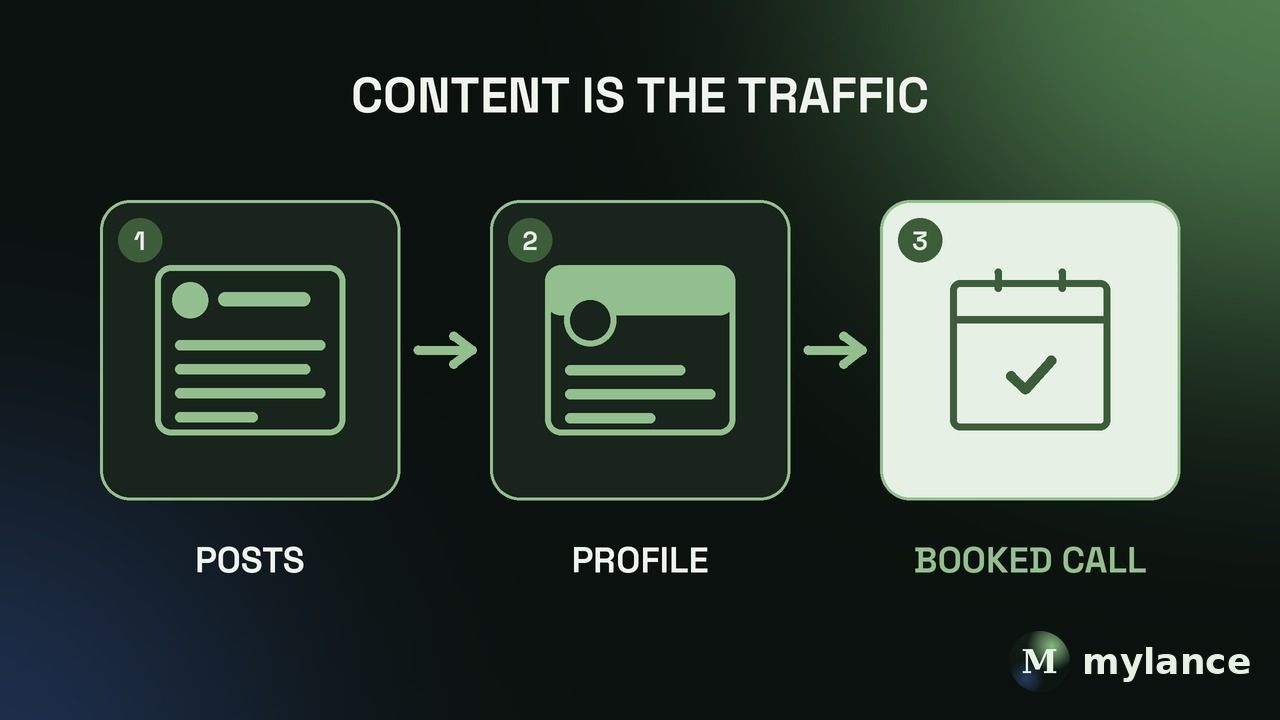
The first thing is your profile. When someone loves your content or someone refers you, the next thing they do is check your profile. It needs to be clear. What do you do, who you help, how you help them, and where you've done it before. That's it. Simple and easy to read. And there should be a way for someone to get into your world even if they're not ready to buy. A newsletter, a lead magnet, a free community. Something that lets someone say yes to you before they're ready to say yes to a paid engagement.
The second thing is adding new connections every day. Twenty new connections on LinkedIn, every single day. It sounds basic. Almost nobody does it consistently. Use Sales Navigator, use an AI tool to pull a list, whatever works. Just click connect twenty times a day. That's the whole instruction.
The third thing is messaging those people. Not pitching them. Reaching out the way you'd introduce yourself at a coffee shop. "Hey, I'm Bradley, this is what I do, glad to be connected." Then let your content run for three or four weeks. Follow up, see if there's a need, offer a free call. Don't push. If they're not ready, that's fine. The moment something changes in their business, you're the name they already know.
Patience is the part nobody wants to hear. Everyone wants the quick win. But this work compounds. When you're putting in the effort consistently, week after week, month after month, it starts to feel effortless because the results start arriving without you having to force them.
This week, pick one: clean up your profile so it's clear in ten seconds what you do and who you help, then add twenty connections a day for the next five days and see what it feels like to actually do it.