ChatGPT or Mylance for LinkedIn Posts? Here's How to Decide
October 28, 2026 · Bradley Jacobs
Get your free LinkedIn positioning in 60 seconds — drop your handle:
The question I hear most from founders and consultants who are already using ChatGPT is not "does AI work for LinkedIn?" They've moved past that. The question is: "Is there something that actually works better?" And they're asking it because they've hit a specific wall, not a general one.
Getting a draft out of ChatGPT is not the problem. The problem is getting a draft you'd actually publish under your own name.
The Real Frustration
Here's what the wall looks like in practice. You paste in some context, maybe a few notes about a client situation or a lesson from last week. ChatGPT produces something coherent. It's grammatically clean, reasonably structured, and completely forgettable. It doesn't sound like you. It sounds like a LinkedIn post about you, written by someone who read your bio once.
So you edit it. You strip out the filler, fix the tone, add the specific detail that makes the story real, and remove the three-part list with the bold headers. By the time you're done, you've spent more time editing than you would have spent writing from scratch.
That's the gap. Not the writing quality in isolation. The gap between getting a draft and getting something that sounds like you and that you're confident will resonate with the people you're trying to reach.
The underlying problem is that LinkedIn content has several distinct jobs, and most people treat it as one job called "writing."
Breaking Down the Actual Work
There are at least five separate jobs inside a consistent LinkedIn publishing habit:
- Deciding what to talk about this week
- Finding the angle that's actually relevant to your audience
- Writing a draft
- Editing it until it sounds like you
- Maintaining a publishing direction that builds something coherent over time
ChatGPT is genuinely good at job three when you set it up well. With strong context, real writing samples, clear instructions about what you hate, and useful feedback on drafts it gets wrong, it can produce something worth editing. That's not a small thing. A good starting draft is real value.
But jobs one, two, and five are where most people stall. Choosing a topic sounds easy until you're staring at a blank page on a Tuesday morning and LinkedIn keeps losing to actual client work. Finding the right angle for your specific audience requires knowing what's resonating with people like yours right now, not just what sounds interesting to you. And maintaining a coherent publishing direction over months is nearly impossible without some kind of structured system.
ChatGPT doesn't have that information. It can't tell you what's performing well for founders in your space this week. It doesn't know which of your previous posts got the most engagement relative to your following size. It starts most conversations with limited context and depends on you to reconstruct everything it needs to do a good job.
That's not a knock on ChatGPT. It's a general-purpose tool doing what general-purpose tools do.
Where Performance Data Changes the Equation
This is where the comparison gets concrete.
Mylance has data on what's actually performing on LinkedIn across all of its users. When a post gets built inside Mylance, it's not working from a guess about what tends to do well on LinkedIn in general. It scans for the top-performing post across all users on the platform, and it also looks at the top-performing post relative to a specific creator's own following.
That second one matters more than it sounds. What resonates with an audience of 800 niche B2B buyers is different from what resonates with an audience of 8,000 mixed followers. A post that performs in the top ten percent for a founder with 1,200 connections might be a different format, length, or angle than what works for someone three times the size. General benchmarks don't tell you that. Your own data does.
ChatGPT is guessing. It can make educated guesses when you give it good inputs, but it doesn't have access to what's actually working right now for people like you.
The other piece is voice. Mylance is built to accumulate understanding of how you write, what you want to be known for, who you serve, and how you've corrected previous drafts. That context doesn't disappear between sessions. It compounds. The amount of supervision required to get a publishable draft should go down over time, not stay flat.
With ChatGPT, that compounding doesn't happen automatically. You can build it manually with careful prompt management, saved instructions, and consistent feedback, but that's work you're doing, not work the tool is doing for you.
Who Should Stay With ChatGPT
Some people should stick with ChatGPT, and I want to be honest about that.
If you're a strong writer who just needs a faster first draft, and you're willing to do the prompt setup and maintenance yourself, ChatGPT with a well-configured custom instruction set can get you a lot of the way there. If you prefer a flexible general assistant you can use across multiple tasks, the context-switching cost of a dedicated LinkedIn tool might not be worth it for you.
ChatGPT also has a real cost advantage. If budget is the deciding factor and you're already paying for it, extracting more value from what you have is a reasonable move.
The people who find Mylance worth it tend to share a specific profile. They know what they do and who they serve. They have real expertise and a track record worth talking about. They believe LinkedIn can generate real business, not just vanity metrics. And they've already tried the ChatGPT workflow and found that the editing burden, the topic-selection problem, or the inconsistency is eating too much time.
They're not looking to outsource their voice. They want to stay in control of what gets published. They just want the gap between having an idea and publishing something they're proud of to be a lot smaller.
The Test Worth Running
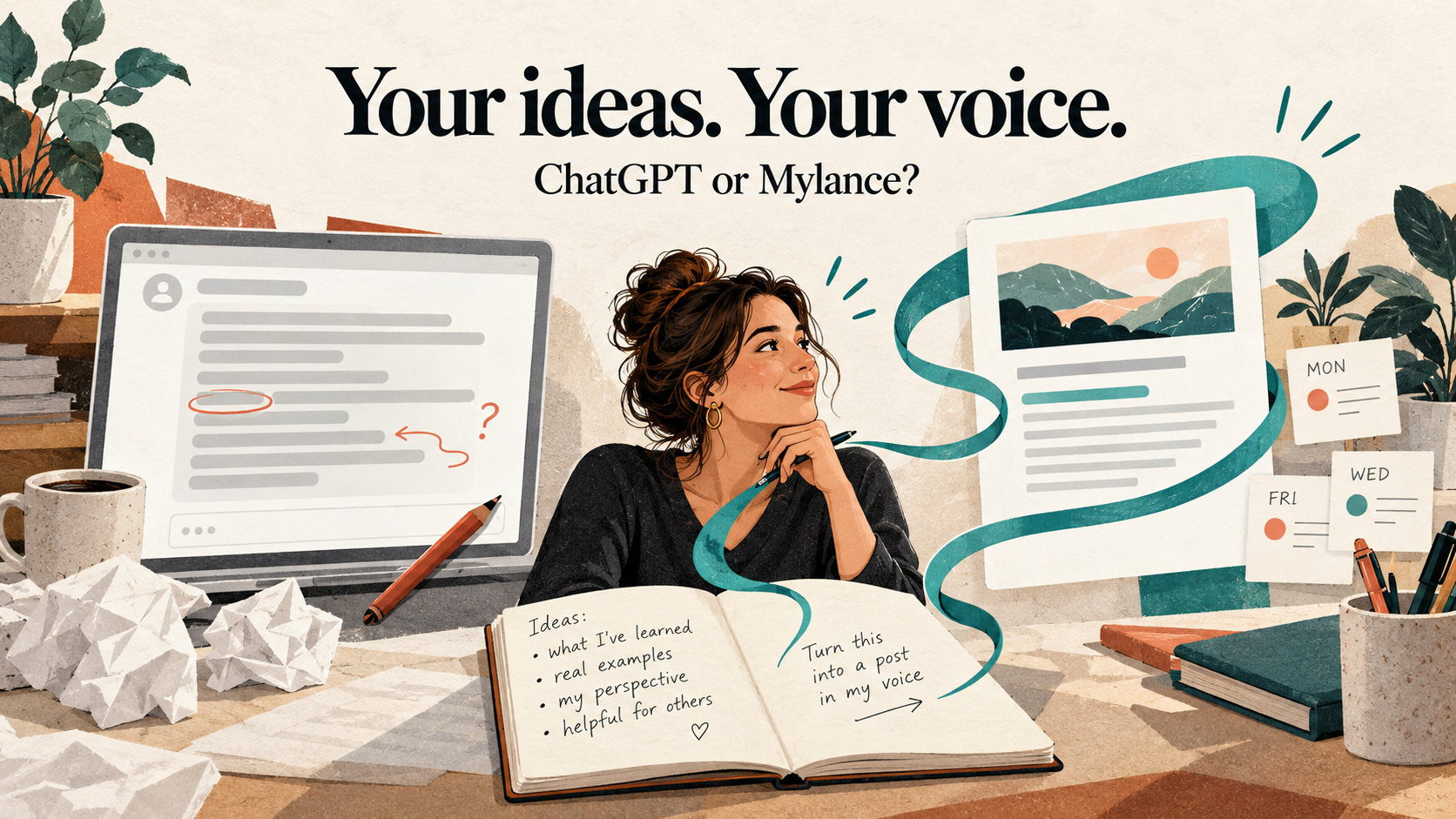
Here's the most honest way to decide: take one real post idea through both workflows.
Pick something specific. A lesson from a recent client situation. A conversation that changed how you think about something in your work. A position you hold that most people in your space would push back on.
Run it through a well-configured ChatGPT setup with your writing samples and clear instructions. Then run the same idea through Mylance. Compare the drafts on four things: how specific they are, whether your actual opinion survived the process, how relevant the angle is to the people you're trying to reach, and how much editing you'd need to do before you'd publish it.
The draft you'd actually stand behind, and the process that got you there faster, is the answer.