The LinkedIn Algorithm in 2026: What 895 Real Posts Actually Show
August 25, 2026 · Bradley Jacobs
See how your own posts score on the levers this study measured:
I've been posting on LinkedIn nearly every day for five years. Call it 300 days a year, so somewhere around 1,500 posts. I've had posts go viral and I've had posts land completely dead.
Here's the honest thing almost nobody writing about the algorithm will tell you: I still can't predict which is which.
My most viral post ever got 750,000 impressions. I wrote it in fifteen minutes, didn't think twice, posted it, and walked away from my computer. I came back 24 hours later and thought, holy shit.
So this isn't a leaked list of ranking factors. Nobody outside LinkedIn has that. What I do have is data. We backtested 895 real posts from 37 creators against actual engagement, and I'll tell you exactly what held up and what didn't.
What we measured, and what we didn't
Being straight about the method matters, because most LinkedIn "studies" are dressed-up opinion.
Every post was judged against its own author's median, not against other people. A 500-follower founder and a 25,000-follower founder are each measured against themselves, so a big account doesn't get credit for being big. "Beat" means a post landed at or above its author's normal.
The honest limitation: LinkedIn doesn't expose impressions through our integration, so we used engagement as the proxy. Engagement sits downstream of reach, so suppression and amplification still show up, but pure reach effects are muted. Anyone claiming to have measured the algorithm directly is claiming access they don't have.
We also ran a held-out split, so every pattern below had to survive on creators the analysis had never seen.
What the data says gets rewarded
Ranked by how well the evidence held up.
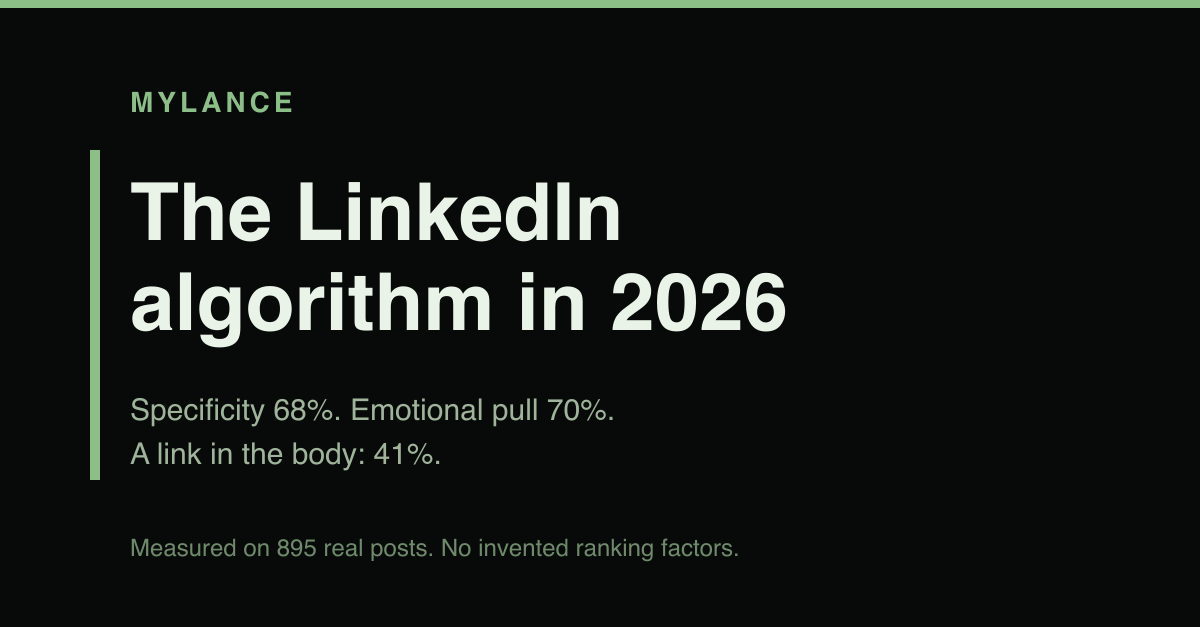
Specificity. Posts high on specificity beat their baseline 68% of the time, against about 50% for vague ones. Named companies, real numbers, concrete detail. "Booked 5 meetings in 2 weeks" beats "drive more pipeline." This one held out cleanly. If you change one thing, change this.
Emotional pull. The cleanest lift in the whole dataset. Low emotional pull beat baseline 51% of the time, mid 60%, high 70%. And this is a separate axis from how informative a post is. A post can be tactically thin, emotionally rich, and still win.
Format, more than most people expect. Beat rates by archetype: Journey or Milestone 72%, Story 60%, Confession 59%, Contrarian 57%, Insight 55%, Client story 55%, Promotional 52%, Question 50%, Community 50%.
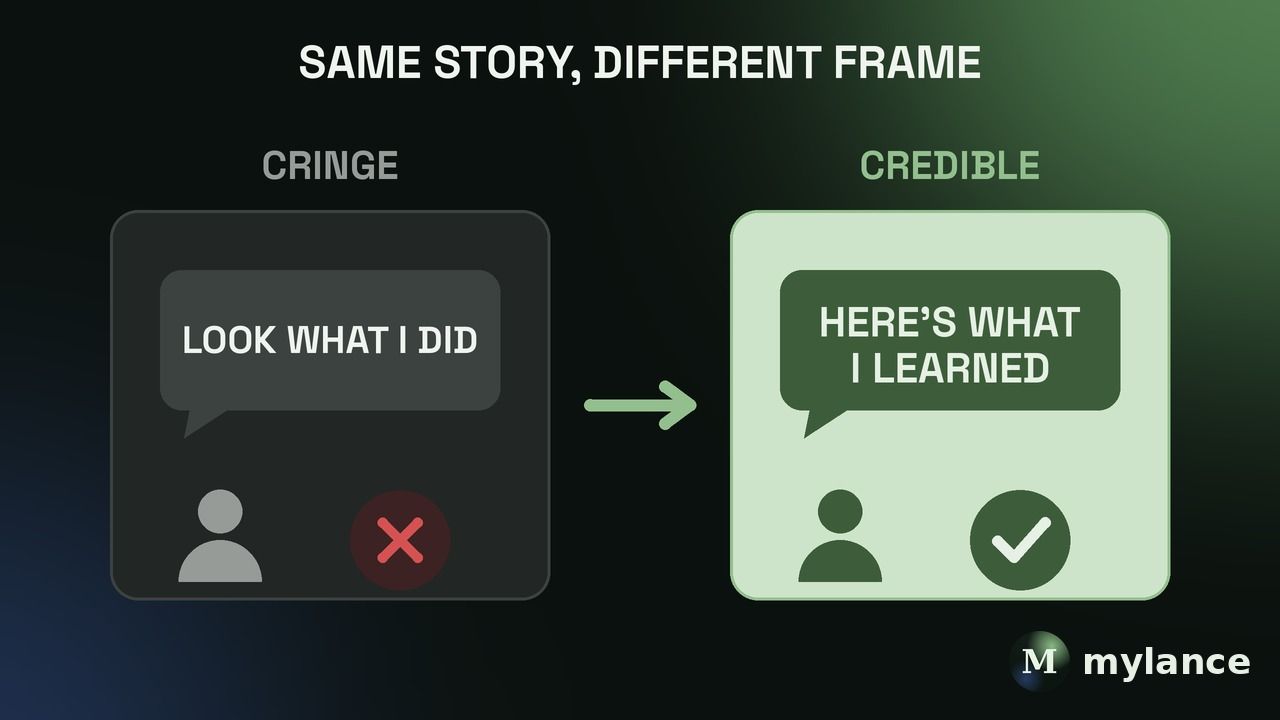
Personal-arc formats beat expertise dumps. The lesson isn't "never teach." It's that a lesson wrapped in a real story beats the same lesson delivered as a lecture.
A number in the first line. Posts with a number or dollar figure in the first 160 characters beat baseline 61% versus 52%. A concrete result up top buys the read.
An image. 61% versus 54% without.
What gets punished
A link in the body. The biggest self-inflicted wound. Posts with an external link in the body beat baseline 41% of the time, versus 56% without. That's a large gap even on an engagement proxy, where reach effects are muted. The fix takes five seconds: put the link in the first comment.
Very short posts. Under 400 characters beat baseline only 33% of the time, by far the worst bucket. Everything from 400 characters up sits between 53% and 59%. The advice to keep it punchy is wrong at the extreme.
Promotional framing. Promo-flagged posts beat baseline 53% versus 56%, and Promotional was the weakest real archetype at 52%.
And the finding that surprised us most: long posts don't underperform. Over 2,000 characters beat baseline 59%, one of the better buckets. Length only hurts when a long post has no payoff.
The thing that doesn't move it
We had an AI judge score every post on quality, blind to how it actually performed. Every quality dimension correlated positively with engagement and survived the held-out split, so craft is real. But the effect sizes are modest, and the judge's single biggest error was over-crediting posts that were clean, well structured, and had nothing at stake.
Among 432 "Insight" posts, the correlation between the AI's quality score and how the post actually did was +0.02. Statistically nothing.
So if your reach dropped and your instinct is to write more carefully, that instinct is wrong. Polish isn't the variable. Specificity and stakes are.
The trap nobody warns you about
Here's where optimizing for the algorithm actively costs you money.
A recruiter came to me once and said she wanted to mimic another guy's LinkedIn content. His stuff was going viral. So we went and looked. He was also a recruiter, and every one of his posts was aimed at job seekers.
I asked her who her client was. Her clients were the companies.
So I said, okay. If he gets a thousand likes from a thousand job seekers, is that helping him win business? Finding job seekers isn't hard. Everybody wants a job, they sign up easily. What's hard is the companies.
Then I asked the real question. If you get a thousand likes from job seekers and ten likes from decision makers at companies, which would you rather have?
She said no doubt, the ten. Or even three.
That's the whole trap. The algorithm will happily reward you for reaching the wrong people. A post can win on every metric on this page and do nothing for your business, because the audience it pulled in was never going to buy from you.
This is why I tell people not to let the likes, the comments and the impressions drive how they feel about showing up on LinkedIn, or how they judge whether the content is working. Those numbers aren't the scoreboard. Who is on the other end of them is.
How often to post
Three times a week, if you can hold it.
Two reasons. One, you're increasing the odds that a post resonates, because we don't know exactly what's going to resonate. We have a good idea, but we don't know. Two, more people see your work over time. One piece a week just doesn't get widely distributed unless it happens to take off, which is rare and not the thing to optimize for.
Consistency isn't an algorithm hack. It's just more chances at the same odds.
What actually changed in 2026
I'm going to disappoint you here on purpose.
I've been through the ups and downs of the algorithm changing for five years, and I can't give you a changelog, because LinkedIn doesn't publish one and I'm not going to invent one. What I can tell you is that every lever above was measured in 2026, on real posts, with a held-out split.
The patterns that win are stubbornly boring and stubbornly consistent: be specific, have stakes, tell it as a story, don't put the link in the body, and don't post a one-liner.
When a post underperforms
Before you blame the platform, check the hook, the specificity and whether the post
committed to a single claim instead of hedging across every angle. Most below-baseline
posts fail one of those three, and very few fail because LinkedIn changed something.
I've written up that diagnostic separately in why your LinkedIn reach dropped.
What to do this week
Work out your own normal first. Roughly your last 20 posts, weighting comments about double a like. Every lever below is measured against that number, so without it you have nothing to compare a post to.
Get the link out of the post body. First comment instead. It costs nothing and it's the single widest gap we measured, 41% against 56%.
Never publish a one-liner. The sub-400-character bucket was the worst performer we found, and it wasn't close.
Open on a concrete figure. A number or dollar amount inside the first 160 characters was worth nine points of beat rate.
Check who's engaging, not how many. Ten of the right people beats a thousand of the wrong ones.
Give it a fortnight before you draw any conclusion. Variance here is enormous, and reacting to a bad week is how people quietly stop posting altogether.
If tracking a baseline by hand sounds like work you won't do, that's fair, and it's roughly why Mylance scores every post against your own rolling baseline and tells you which of these levers it missed. But the method matters more than the tool. Measure against yourself, move the links, and give it a month.
Keep reading: How to Write a Viral LinkedIn Post (700K Views, Broken Down)
Frequently asked questions
How does the LinkedIn algorithm work in 2026?
Nobody outside LinkedIn can answer that precisely, and anyone who claims a definitive ranking-factor list is guessing. What we can measure is which post traits correlate with beating a creator's own baseline. In our study of 895 posts, the strongest were specificity (68% beat rate when high) and emotional pull (70% when high), followed by personal Journey and Milestone formats at 72%.
Did the LinkedIn algorithm change in 2026?
LinkedIn doesn't publish a changelog, so I won't pretend to have one. I've posted about 1,500 times over five years and been through plenty of shifts. What has not changed is which traits correlate with winning: specific, emotionally loaded, story-shaped posts, with no link in the body.
Do links hurt your reach on LinkedIn?
Yes, and it was the widest single gap we measured. Posts carrying an external link in the body cleared their author's baseline 41% of the time. Posts without one cleared it 56% of the time. Because our measure is engagement rather than raw impressions, the true reach penalty is plausibly larger, not smaller. Move the link to the first comment.
How often should I post on LinkedIn?
Three times a week is the number I give people. It raises the odds that something resonates and it compounds reach over time. One post a week rarely gets distributed widely unless it happens to take off, which is rare.
Does the LinkedIn algorithm punish AI-written posts?
I have no data on a platform-level penalty, so I won't claim one. What I see on calls is a reader penalty, which is worse and harder to measure. Your buyer decides you're not worth reading and you never find out.
What's the best time to post on LinkedIn?
We didn't test posting time, so I don't have a number for you. I'd spend that energy on specificity instead, where the effect is measured and large.