Finding Clients
I Just Completely Changed My Sales Process and Stopped Pitching
October 7, 2026 · Bradley Jacobs
Get your free LinkedIn positioning in 60 seconds — drop your handle:
I've completely stopped pitching on sales calls.
The weird part is I've known for years that pitching doesn't work. When people bought from me, it was because I asked questions, stayed curious, showed them the product. But I couldn't tell you exactly why they bought. I had no framework. I was just winging it and getting lucky sometimes.
That changed when I started reading Rob Snyder's book, The Power of Pull, and went through his founder bootcamp. What I found there reorganized how I think about every single sales conversation.
In this issue
Why pitching is the wrong goal on a sales call. The four-part framework that replaced it. How it plays out for Mylance and for a UX designer. And the honest close that actually works.
The Problem With Pitching
Here's what pitching does. It puts you in the position of trying to convince someone. You explain what you do, what makes you different, why they should care. And at the end, you hope they say yes.
I got on a call recently with an SEO agency founder who spent ten minutes doing exactly this. He walked me through who they work with, what makes them different, what's been working in their outreach. He'd even sent me an SEO audit video beforehand, which I watched.
I sat there thinking, what is he hoping this accomplishes?
I already have my own SEO process using mostly AI and some human intervention. I'm ranking higher on Google. I'm not paying $2,000 a month for someone else to do it. He didn't know any of that because he never asked. He just talked at me for ten minutes and then I told him it wasn't something we needed right now. He walked away with nothing. No insight into why I passed, no understanding of what I actually believe, no information he could use.
That's what pitching produces. A yes or a no, and usually a no, and you don't learn anything either way.
The Four Parts That Replace It
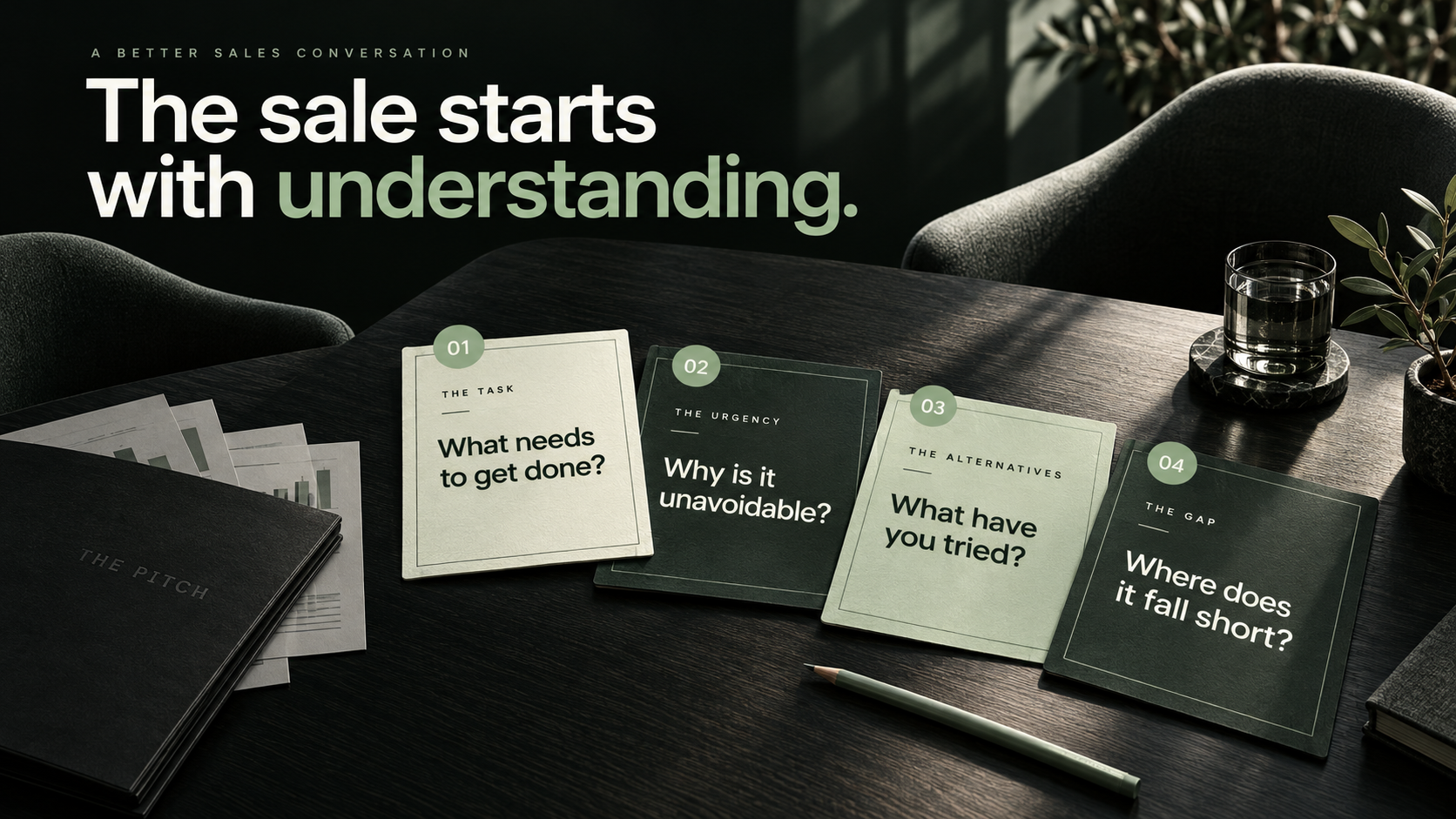
The framework comes from Rob Snyder's Power of Pull, and the core idea is this: people don't buy because they have a vague problem. They buy because they have a specific task that is unavoidable.
People have tons of problems they never pay to solve. The question is what makes someone actually act. And the answer is that the task has to be real, it has to be urgent, and their current options have to be failing them.
So here are the four things I'm diagnosing on every call now.
First, there's a specific project or task to be done. Not a fuzzy pain point. A real thing on their to-do list.
Second, that task is unavoidable. They have to do it. There's no scenario in their mind where they just skip it. Sometimes that's a compliance requirement. Sometimes it's a belief system, like this has to happen for my business to hit its goals.
Third, there are other options. There always are. Competitors, DIY, doing it manually, using AI. I need to know what they've already tried.
Fourth, those options are insufficient. This is where the real buying signal lives. If their existing solutions are working fine, I'm not their customer. If those solutions are failing them, I might be.
I have twelve questions I ask every single customer now. By the time we're done, they're either a clear yes or a clear no. And when it's a no, it's not because I failed to sell hard enough. It's because the fit isn't there.
What This Looks Like for Mylance
Let me walk through the framework with my own product so it's concrete.
The task to be done: the customer needs to show up consistently on LinkedIn, demonstrate expertise, attract clients, and stay top of mind for their network.
The unavoidable part: they believe that if they don't do this, they won't hit their business goals. But here's where it gets nuanced. It's not just that LinkedIn feels important in the abstract. It's that they genuinely believe LinkedIn works for them. If they're skeptical of LinkedIn, they might try Mylance for a month or two, but they're not my ideal buyer. My ideal buyer already knows LinkedIn works. So I ask directly: what's your level of conviction that LinkedIn works for you? That one question tells me everything.
The other options: most of my customers have already tried generic AI. They've used Claude or ChatGPT. And what they got back was fluffy, invented, full of the kind of negation-then-assertion language and AI tells that make it obvious no real human wrote it. It didn't sound like them. It didn't use their actual experience.
The insufficiency: the number one thing I hear is that it's not authentic. They won't post that kind of content. So when I understand exactly where that frustration lives, I know what language to use everywhere, in my positioning, in onboarding, in how I describe what Mylance does. LinkedIn content that actually sounds like you. That's not a tagline I invented. That's what my customers tell me they need.
The UX Designer Version
Say you're a UX designer on a call with a potential client. You could open with, "I'm the best UX designer you'll find." And they'll say, "Great, we're good right now."
Or you could ask: how do you currently handle customer flows and design screens? How well is that working? How important do you think UX is to your product's success? Do you have any UX resources on your team, and how well are they solving it?
If the client comes back with, "Our flow is terrible, customers are dropping off, we don't have an internal resource, and AI isn't cutting it," that's a completely different conversation. You didn't convince them they had a problem. They told you. And now they're curious whether you can fix it.
That's when they start asking logistical questions. What would it look like to get started? What do you need up front? How much time does this take? Those questions are the signal. They're mentally running through what working together would actually look like.
The Close That Works
When I hear those logistical questions, I don't rush to close. I ask one thing: "Be super honest with me. Where's your head at right now? You won't hurt my feelings."
Most people tell me the truth. And I can tell when they are. I had a customer say he was going on vacation for a week and would sign up when he got back. That could easily read as a polite brush-off. But based on everything else in that call, I believed him. I followed up a week later: "Hope your vacation went well. Anything holding you back from getting started?" He said no and paid. Done-for-you customer.
The shift in mindset is this: I'm not trying to get a yes. I'm trying to find out where someone actually is. If it's a fit, they'll say so. If it's not, I want to know that too, because it tells me something useful about my product, my questions, or my positioning.
Talk to enough people with this framework and the pattern gets clear. The right customer doesn't need convincing. They need to realize, out loud, that the task is real, it's unavoidable, and what they've tried isn't working. Your job is just to ask the questions that get them there.