How Fractional Executive Engagements Are Actually Structured
August 26, 2026 · Bradley Jacobs
Get your free LinkedIn positioning in 60 seconds — drop your handle:
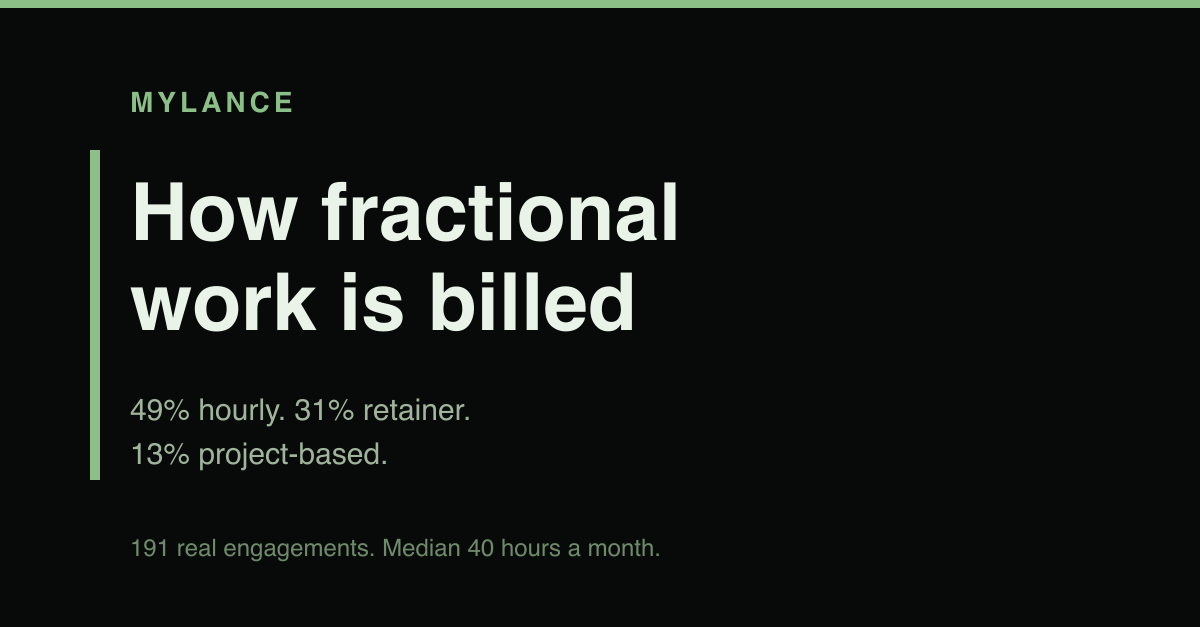
Most fractional executive work is billed hourly, not by project. In a survey of 191 real engagements from 152 independent operators, 49% were hourly, 31% were a monthly retainer, 13% were project-based and 5% were weekly. The median engagement was 40 hours a month.
That is the short answer. Below is where the numbers came from, what they mean when you are negotiating, and the parts nobody puts in a comparison table.
The billing split, measured
We run a rate and engagement survey inside the Mylance community. After removing duplicate submissions, 191 engagements from 152 people, here is how they were actually billed:
Hourly: 49%. Still the default, despite years of advice telling consultants to abandon it.
Monthly retainer: 31%. The second most common, and the one most experienced operators move toward.
Project based: 13%. Much rarer than the internet implies.
Weekly: 5%. A small but real category, usually for embedded work.
Other: 2%.
So if someone tells you fractional work is "usually project-based," they are wrong by a factor of about four. Half the market is still billing by the hour.
How much time you actually get
The median engagement was 40 hours a month. The middle half ran between 20 and 60 hours.
The full distribution matters more than the median, because "fractional" covers wildly different commitments:
1 to 10 hours a month: 20%. Advisory. A standing call and some async input.
11 to 25 hours: 22%. Roughly a day a week.
26 to 50 hours: 28%. The largest single band. Somewhere between one and two days a week.
51 to 80 hours: 17%. Half-time or close to it.
Over 80 hours: 13%. At this point the word "fractional" is doing a lot of work.
If you are hiring, that spread is the thing to pin down first. Two people quoting the same monthly number can be offering a four-times difference in actual time.
Who is actually buying
Company stage, from the same 191 engagements:
Series A to C: 25%. The largest group.
Seed: 22%.
SMB, not venture backed: 14%.
Pre-funding or bootstrapped: 10%.
Publicly traded: 8%.
Pre-seed: 6%.
Nearly half of this work sits at seed through Series C. That is a company with real money and no appetite for a full-time executive hire yet, which is exactly the gap fractional work fills.
What this means if you are quoting
The billing split tells you something uncomfortable: hourly is winning on volume, and hourly is the worst structure for you.
Hourly punishes you for getting better. Get faster at the same outcome and you earn less for it. A retainer does the opposite.
The data says experienced operators work this out. Billing basis by years of experience:
Under 5 years: 73% hourly, 20% retainer.
6 to 10 years: 57% hourly, 23% retainer.
11 or more years: 39% hourly, 40% retainer.
Hourly falls from 73% to 39% as experience rises, and retainers climb from 20% to 40% until they overtake it. Nobody announces this shift. People just quietly stop selling their minutes.
The practical move is not to refuse hourly work. It is to set the retainer by deciding how many hours a month the client gets, multiplying by your rate, and then holding the scope. Price the access, not the minutes.
What this means if you are hiring
Ask for hours a month before you ask for a rate. A $6,000 monthly retainer is either expensive or a bargain depending entirely on whether it buys 15 hours or 60.
Expect hourly. Half the market quotes that way. If you want a retainer, you will often be the one proposing it.
Match the band to the problem. Advisory input is a 1 to 10 hour engagement. Owning a function is 26 to 50. If you are asking for 80 hours a month, you are describing a part-time employee and should price it like one.
Ask what happens when the scope moves. This is the question that separates a clean engagement from a bad one, and it is not in any comparison table.
How to read these numbers
These are self-reported by independent consultants inside our own community, not a random sample of the whole market. Responses were collected over several years rather than in one snapshot, so treat them as directional rather than as a current market rate card. We removed 16 duplicate submissions before counting, and 32 people appear more than once because they reported multiple engagements.
We publish them because the alternative on most sites is a range with no source behind it at all.
Frequently asked questions
Are fractional executive services typically hourly or project-based?
Hourly, by a wide margin. In our survey of 191 real engagements, 49% were billed hourly, 31% were a monthly retainer, 13% were project-based and 5% were weekly. Project-based work is far less common than most guides suggest.
What is the typical contract structure for fractional executive services?
The most common structure is an hourly rate against an agreed number of hours per month, with a monthly retainer as the second most common. The median engagement is 40 hours a month, with the middle half between 20 and 60. The number that matters in the contract is hours per month, because it is what makes a monthly figure comparable between two candidates.
How many hours a month does a fractional executive work?
Median 40, with the middle half between 20 and 60 hours. The distribution is wide: 20% of engagements are under 10 hours a month and 13% are over 80. "Fractional" describes the arrangement, not the size, so always confirm the hours.
What stage of company hires fractional executives?
In our data, 25% of engagements were with Series A to C companies and 22% with seed-stage companies. SMBs that are not venture backed accounted for 14%, bootstrapped 10%, publicly traded 8% and pre-seed 6%.
Do experienced fractional executives charge differently?
Yes, and it is the clearest gradient in our data. Consultants with under 5 years of experience billed hourly 73% of the time and used a retainer 20% of the time. At 11 or more years, hourly falls to 39% and retainers rise to 40%, overtaking it. Experience does not just raise the rate, it changes the structure.
Should a fractional executive charge hourly or a monthly retainer?
A retainer is usually the better business, even though hourly is more common. Hourly billing reduces your income as you get more efficient at the same outcome, while a retainer prices access rather than minutes. Set it by agreeing the hours per month and multiplying by your rate, then hold the scope.
How do you negotiate fees with a fractional executive?
Start with hours per month rather than the headline number, because that is what makes two quotes comparable. Then ask what happens when scope changes, since that is where most engagements go wrong. Expect an hourly quote roughly half the time, and expect to be the one proposing a retainer if you want predictability.