LinkedIn Company Page vs Personal Profile
September 3, 2026 · Bradley Jacobs
Get your free LinkedIn positioning in 60 seconds — drop your handle:
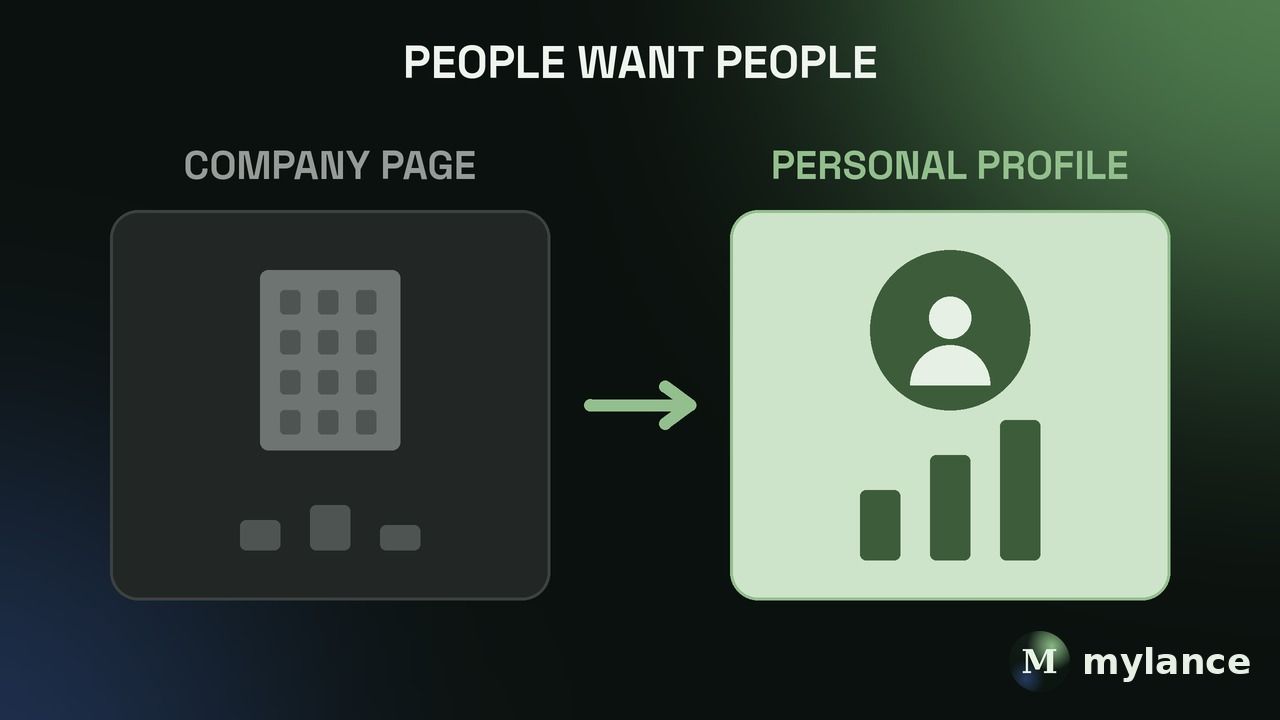
If you are choosing between a LinkedIn company page and a personal profile, post from your personal profile first. People want to hear from people. Use the company page to support, organize, and amplify the business. Do not make it the center of your content strategy unless you already have a real audience there.
I run a company. I still put the vast majority of my energy into my personal page. The Mylance company page gets reposts from me and an occasional video. It is nowhere close to what I do on my personal profile.
That is not because company pages are useless. It is because the two pages have different jobs.
Which should come first: your LinkedIn company page or personal profile?
Your personal profile. Pretty decisively.
If you run a business, a practice, an agency, or a consultancy, the advantage is already sitting in your head. You have learnings, wins, mistakes, customer patterns, and a first-person point of view. A logo cannot tell those stories. You can.
On a workshop call, I put the caveat as bluntly as I could: “People want to hear from people. They don't want to hear from companies.” If you only post in one place, post on the personal page. Make the company page a little bit of an afterthought.
A company page speaks as an institution. A personal profile speaks as a person with a history, a reputation, and some skin in the game. For trust, that difference is massive.
Why does the personal profile usually get better engagement?
Because people can attach the idea to a human being.
You have seen the opposite all over LinkedIn. A company announces something in polished brand language. It is safe. It is clean. It says almost nothing. Then the owner writes what happened, what went wrong, what surprised them, and what they would do differently. That is the version people read.
The goal is not to manufacture vulnerability or perform LinkedIn theater. It is to share something specific that you actually know. Great content starts with great positioning. Once you know who you help and what you understand better than most people, your personal experience gives that positioning proof.
I use one story as an example. Uber and Lyft launched Raleigh on the same day. Six months later, Uber had 90% market share. I was on the Raleigh launch team, so I wrote about the four things we did to win.
That post generated 700,000 impressions and 22 inbound leads. It was an outlier—the most viral post I had written—not a promise about what every post will do. The useful part is why it worked: it was specific, easy to skim, based on personal experience, and written from a first-person point of view. Nowhere did I say, “Come work with me.”
A company page could summarize that lesson. It could not honestly say, “I was there.” That is the personal-profile advantage in one sentence.
What is a LinkedIn company page actually for?
Think of the company page as infrastructure and reinforcement.
It gives the business a legitimate home. It can explain what the company does, collect followers, publish company-specific news, highlight team members, share product updates, and make the brand easy to verify when somebody clicks through from an employee or owner profile.
It can also extend good personal content. You can repost it, comment on it, add a quote, or turn the underlying lesson into an original company post. On the call, I mentioned inviting people to follow the company page, too. All of that is fine.
Just do not confuse having a page with having an audience. Filling a company page with generic brand copy does not create trust. It creates a content archive nobody asked for.
Should you post the same content on both?
Not word for word, every time.
Start with the strongest point of view on the personal profile. That is where the story, opinion, lesson, win, or mistake belongs. Then decide whether the company page has a useful role.
A simple split works: the personal profile owns experience and interpretation; the company page owns company proof and context. Personal: “Here is what I learned after watching this fail.” Company: “Here is the change our team made because of that learning.” Personal: “I was wrong about this customer behavior.” Company: “Here is how the product now handles it.”
The two can reinforce each other without sounding duplicated. One is the human point of view. The other is the institutional record.
What should you post from your personal profile?
Use the material your work is already producing: decisions, customer questions, hard calls, false starts, wins, mistakes, and lessons you had to earn.
Specific is so important on LinkedIn. “Here are five leadership tips” can come from anybody. “Here is the decision I made with six weeks of runway and what I missed” belongs to you.
This is also how you avoid AI slop. AI can polish a thought. It cannot supply the detail of a room it was never in, a tradeoff it never made, or a customer pattern it never noticed.
My rough content ratio is five out of six posts giving value: teaching, learning, and sharing experiences. One out of six—or less—can explain what you do and how people can work with you. Most of your feed should not sound like an ad.
How often should each page publish?
Put your consistency budget into the personal profile first. I argue for a minimum of three posts a week there if LinkedIn matters to the business.
That does not mean your whole network sees you three times a week. LinkedIn does not show every post to every connection. I have 26,000 followers and post daily. There is no chance all 26,000 people see every post.
The company page can run at a lighter cadence. Publish when there is real company context, a useful original idea, or a strong personal post worth amplifying. Do not create filler just to keep the logo active.
How do you know whether the personal profile is working?
I pay attention to profile views.
In one 90-day window, I had 3,166 profile views. Forget the vanity debate for a second. That is more than 3,000 people landing on the page where I explain what I do, who I help, and how to stay connected.
The post is the doorway. The profile is the landing page. Make sure the headline, About section, Featured section, and company link tell one coherent story. If the content says one thing and the profile says another, you waste the attention.
For the company page, look for a different kind of signal: do the right people verify the business, follow it, engage with meaningful updates, or move from a team member's post into the company story? The company page assists the journey. It usually does not start it.
What if writing for LinkedIn keeps falling to the bottom of the list?
That is the real problem for most experienced people. You already have something valuable to say. Turning it into credible content consistently takes too much time and mental energy.
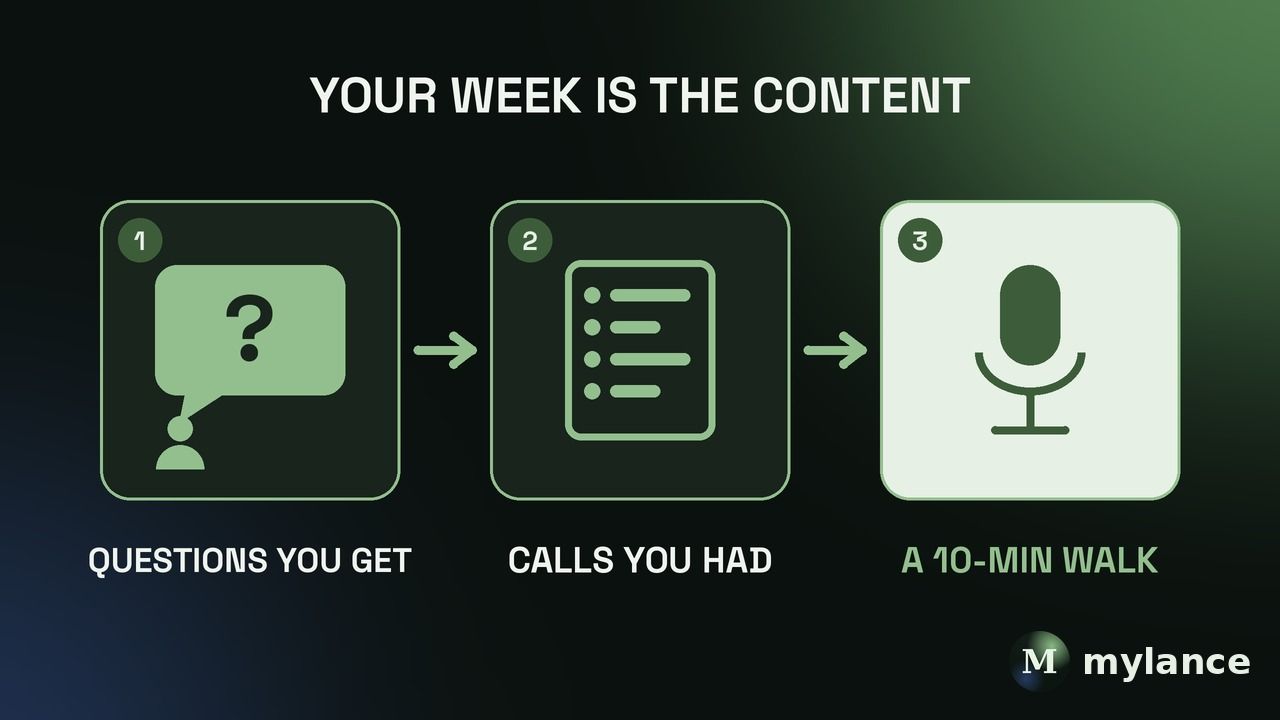
Create a forcing function. Capture the useful moment when it happens—a voice note after the customer call, three bullets after the decision, the sentence you keep repeating to your team. Then turn those raw materials into a post later.
Mylance helps you turn what you know and do into LinkedIn posts that sound like you.
The point is not to invent your positioning or manufacture generic social copy. It is to make the expertise you already have easier to share from the page that earns attention: yours.
Do business owners need both a company page and a personal profile?
Usually, yes. You need the personal profile to build human familiarity and the company page to give the business a credible home. But if time is limited, make the personal profile excellent before trying to make both equally active.
Can a company page replace the owner's personal content?
Not well. It can carry announcements, proof, and company context. It cannot replace the owner's lived experience and first-person point of view.
Should employees repost every company post?
No. Give them something worth adding to. A short personal observation is usually more credible than a wall of identical reposts.
What is the simplest LinkedIn company page vs personal profile strategy?
Publish useful first-person content from the personal profile three times a week. Let five out of six posts teach or share experience. Use the company page selectively for company proof, original company updates, and amplification. Measure profile views and business-relevant engagement, not just company follower count.
Personal page first. Company page in support. That is the answer.