
Niche
How to Niche Down as a Consultant (One Buyer, One Problem)
November 3, 2021 · Team at Mylance
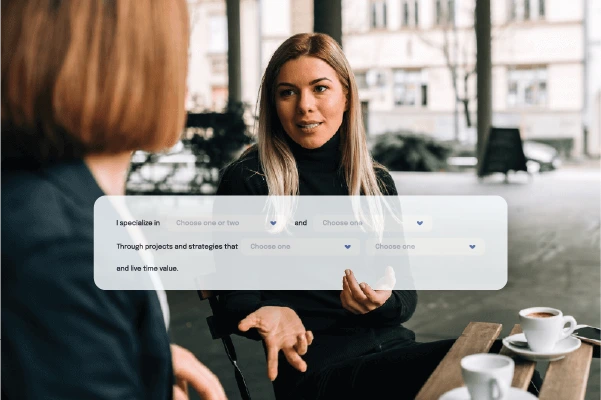
Get your free LinkedIn positioning in 60 seconds — drop your handle:
You niche down as a consultant by naming one buyer and one problem you have already solved. Not a broader title. A specific offer a decision maker can answer yes or no in two sentences.
This is for people who already have a practice. You have done the work. You can close.
You are not trying to "become a fractional." Fractional is a work style. It is not a niche.
If I tell you I am incredible at strategy, operations, and helping you scale, you still do not know what I do. Am I a product person. A go to market person. An internal ops person. A PR person. You cannot buy that sentence.
Narrow until a decision maker can hear two or three sentences and know whether they have the problem. Do we have this problem. Not do we need services.
1. Pick one buyer, not a category of humans
Who pays. Title, company type, size, situation.
I coached Greg Buechler live on this. Thirty years in talent acquisition.
He grew up in Silicon Valley. Intel, Apple, startups.
He wanted smaller to midsize companies with high EQ management, people who share some gray hairs with him.
We kept shrinking the company until it was usable. Not 25 to 500 people. Those companies do not have the same problems.
We landed on about 50 to 200 employees. At least 10 years old. Tech SME, often B2B.
English as the language of the business. No recruiter, head of recruiting, or VP of talent acquisition sitting there right now.
That is a buyer. "I recruit for great companies" is not.
When I left Uber Freight I had a buyer too. Freight brokerages that grow by throwing people at the phones. Thousands of people. I ran the team focused on automation so we did not need to hire like that.
Advising CEOs is still not a niche. Raising money points you at VC-backed founders.
Taking a bootstrapped company from 3 million to 10 points you at a different buyer with a different offer. Same revenue target. Completely different advice.
If you cannot name the company out loud, you do not have a niche. You have a resume.
2. Pick one problem, not a laundry list
A customer of mine posted that he left his job and was starting to consult. The post did well. Over 100 likes. Probably 5 to 10,000 impressions. No clients.
Then he listed what he was offering. Fractional digital marketing. Marketing leadership. SEO. Marketing automation and email. Paid media. Web dev. Analytics.
I do not know what he does. I do not know who it is for. I cannot tell if he is a $5 an hour Upwork SEO or the person who does SEO at Zapier. So I am not surprised it produced zero work.
You already know this from the other side. You get the LinkedIn DM with 12 services. You ignore it. "I help you with your brand" is the same post with fewer bullets.
Lead with the problem. A fractional CMO once asked me if I was struggling without a marketing lead to expand the reach of my current marketing efforts. I was. He did not start with SEO tactics. He named the hole I was sitting in.
For Greg, the pain we wrote down was haphazard hiring. Data in different places. No consistent process.
Bad candidate and hiring experience. The company misses the best people.
The internal team starts to hate interviewing. The business suffers because they cannot hire to their needs.
One problem. You can hold a second version and test it on the next five calls. You cannot lead with seven.
3. Only sell what you have already solved
The money is in paying you to avoid mistakes you have already made.
People tell me they have been a designer their whole life and they really want to get into product management. Fine. Get in the door with design. Nobody is hiring you as a consultant to experiment with a new career.
When I talked to a freight company I asked how they were thinking about scaling without throwing tons of people at the problem.
Then I told them what I did at Uber Freight. I ran the automations team.
My job was product and process so we did not hire our way into a mess. That is why they were intrigued.
I could not have walked in and said I would also handle their marketing.
A series A company reached out because I was posting about launching Uber Eats. They were launching a food delivery marketplace. They wanted a head of operations. I turned it into consulting. They paid so they could see around corners I had already walked around, including Miami and Milan.
Make a list of problems you have already solved. Write the company next to each one.
Series A fintech. Five year old B2B SaaS that plateaued. Freight brokerage adding headcount instead of software.
The thread is your niche. The how comes later, on the call and in the proposal.
Your niche is the overlap of who you want to work with and problems you are a 10 out of 10 on.
4. Write one sentence a stranger would not rewrite as "consultant"
Quick test. If someone asks what you do and they look confused, you failed. They should know who it is for, the problem, and the value in one sentence.
Mine on intro calls was this. I specifically work with freight brokerages who have not yet adopted a lot of technology and process, that enables you to grow without adding tons of headcount.
Who. What. Problem. People's eyes would light up. They were adding thousands of people. They needed that sentence.
Greg's draft landed here. I am a fractional talent acquisition executive who implements a frictionless, high EQ process for tech SMEs who currently have a haphazard approach to hiring, leading to a bad candidate experience and low candidate acceptance rates.
Long is fine. Vague is not. We cut "high touch, transparent" because four adjectives is a pile. He kept frictionless and high EQ. We put care and integrity in the bio and on the call, not in the hook.
His old headline was keyword soup. Fractional talent acquisition leader. Curator of great candidate experiences. ATS selection and implementation. That tells me tools. It does not tell me the mess I am in.
You can have a short answer for your cousin and the long sentence for a buyer. The long sentence is the one that belongs on LinkedIn.
5. Go a layer deeper than the job function
When I hire, I do not buy "email marketing." I buy Klaviyo. I do not buy "we improve efficiency." I buy someone who has built Zapier automations with Klaviyo, Webflow, and Airtable.
The person whose headline said they were an automations expert with Zapier got the work. The person who improves efficiency did not, even though that was also true.
"I help you with your digital marketing strategy" is a buzzword.
"I help fintech startups get marketing attribution so you know which customers are actually driving growth" is a problem.
If I cannot do CAC by channel, I do not know where to put money. Now I will take the call.
You can add a second skill as a differentiator. A marketer who can also read the analytics. A content person who understands which channel is working. The differentiator sits on top of a narrow problem. It does not replace it.
People fight this because they are scared the buyer will not have that problem. Good. Not everyone will.
Broad copy gets you zero replies because it resonates with nobody. Narrow copy gets fewer people, and those people raise their hand.
6. Put the sentence everywhere, then prove it with stories
Headline. About. The way you answer "what do you do." Outreach. Proposals. The first three lines of a LinkedIn post.
Then prove it with work you lived. Not a preachy "you should." A story.
Uber Miami did 1,003 orders on the first day of Uber Eats. Average order around $30. About $30,000 in one day, in one market. Sharing that from the inside is how a marketplace company decides you can see the corner.
The Raleigh UberX post did the same job. Same product, same day as Lyft. 90% share in six months because we stayed small, ran five minute ETAs, and did not expand early. 700,000 impressions. 22 inbound leads. People trusted the firsthand account, not the job title.
You do not need a new website for this. LinkedIn is where the buyer looks. I am not going to offer to build you a site. I am going to tell you to make the sentence true, then show up every week in your voice so the right companies can find you.
Three times a week is enough to start. The profile they land on has to match the sentence. If the post is specific and the headline is "fractional leader," you undid the niche in one click.
I live in Austin. I came out of Uber. The consultants who get found are not the ones with the broadest title. They are the ones who named one buyer, one problem, and kept saying it until it was boring.
If you want help locking that sentence and getting two posts that sound like you, start free at https://app.mylance.co/onboarding. Positioning plus two posts. No card.
Frequently asked questions
How do you position a founder as an industry expert?
Narrow what you claim until it is specific enough to be believable, then show proof. The post works through an example: a marketer with eight years in B2C pet care can call herself a Content Strategist for tech companies, or a Content Strategist for B2C pet tech companies. Both are true, but the second names a much smaller field and makes her the obvious choice inside it. Once the claim is specific, back it with deliverables and numbers from work you have actually done, the industry experience that built the expertise, and references that speak to the impact you made.
How long does it take to become known as an expert in your niche?
The post does not put a timeline on it, and the honest answer is that it depends on how narrow your claim is and how much proof you already have. What it does argue is that the gate is not audience size. Most people assume they need thousands or tens of thousands of followers before any of this generates leads, and that is not the case: a small but dedicated audience plus thoughtful, insightful content produces leads, while a large undifferentiated following does not. Being specific and consistent in one space gets you there faster than waiting to be big.
What is a niche expert?
A niche expert is someone known for one specific, well-defined area rather than for being a generalist. The strongest version combines a hard skill with an industry, so not just SEO but an SEO blogging expert for B2B fintech companies. The post's one caveat is that the niche has to be profitable and growing, so pick it from your real industry and work experience rather than picking a label that sounds good.
Can you niche down and still expand your reach?
Yes, and the post argues this is the usual mistake. Founders cast a wide net believing it improves the odds of closing deals, and the fear is that niching down closes doors to potential business. It does the opposite. Being a niche expert is the main thing that separates you from everyone else offering something similar, and it gives a prospect a concrete reason to hire you and to pay more, because a specialist reads as more trustworthy than a generalist.