He Built Brands at Salesforce, LinkedIn, and WeWork. Here's Why Your Self-Promotion Is Backwards.
July 8, 2026 · Bradley Jacobs
Get your free LinkedIn positioning in 60 seconds — drop your handle:
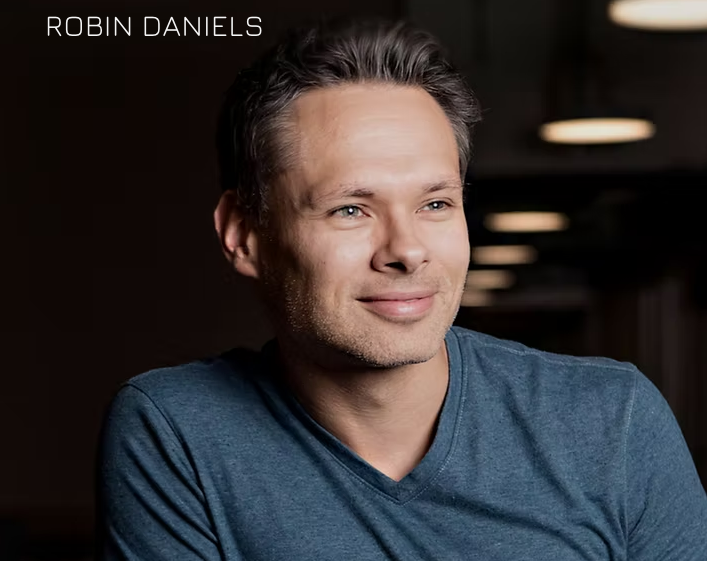
What follows is a detailed breakdown of a recent conversation with Robin Daniels - and a field guide for turning his hard-won lessons into more clients and bigger projects.
Robin's resume reads like a tour through the last two decades of enterprise software: Salesforce, LinkedIn, Box, Matterport, WeWork. He's helped take companies public two and a half times - Box and Matterport crossed the finish line; WeWork famously didn't. He had a front-row seat as WeWork's valuation rocketed from $20 billion to $47 billion and then vaporized before the IPO ever happened. Today he's Chief Business Officer at Zensai and the co-author of The Human Success Playbook.
If you're a fractional executive, you might wonder what a guy who ran 400-person global marketing teams could teach you about landing your next client. Almost everything - because the principles that build billion-dollar brands are the same ones that fill a pipeline. Most people just run them in reverse.
Sell the vision, not the spec sheet
Here's something worth sitting with. Every company Robin built a brand for sold something fundamentally boring. Salesforce sold a CRM. Box sold file sharing. WeWork sold office real estate. None of it screams excitement.
And yet none of them marketed it that way. WeWork wasn't selling desks - it was selling the idea that bringing people together in a shared space could create something none of them could build alone. The product was dull. The vision wasn't.
This is the exact trap most consultants fall into. You lead with your methodology, your years of experience, your tidy list of deliverables - the spec sheet. Robin's rule cuts straight through it: people buy with emotion, then support that decision with logic, facts, and data. Never the other way around.
His prescription is almost too simple: market yourself like a B2C company, even though you're as B2B as it gets. When he runs marketing workshops and asks people to name their favorite brands, nobody says a CRM vendor. They say Nike, Apple, Patagonia, Tesla. So the move is obvious - borrow the emotional hook those brands use and aim it at your offer.
Your buyer is a human, and they're already on LinkedIn
The objection Robin hears constantly is the same one fractional execs love to hide behind: my buyer isn't on social media - they're too senior and too busy for that.
He doesn't buy it, and neither should you. The CFO signing your contract scrolls Instagram and TikTok in the evening like everyone else. The second she walks out of the conference room, she's a human being again.
Even in a brutally complex enterprise sale, Robin points out, there's one human champion who has to fall for your idea first - and then carry it back inside the company, armed with the logic and data to win over everyone else. Your only job is to hook that one person emotionally. Talk to them like a person. It's really not that hard.
The courage to be seen
At 21, Robin bought a one-way ticket from Copenhagen to California with no plan and no safety net. What made it possible wasn't fearlessness - it was a reframe. Denmark wasn't going anywhere; it had been around a thousand years. If California flopped, he could always go crash on a sibling's couch. The downside was survivable. The regret of never trying wasn't.
That calculation is what separates high performers from everyone else. The fear that drives them isn't the fear of failing. It's the fear of not trying - and wondering, at 60, what might have been.
It's the same fear that keeps consultants invisible. Fear of posting something that flops. Fear of looking like a self-promoter. Fear that ten people will think your idea is stupid. The most useful gut-check to come out of the conversation was a blunt one: can your ego survive a few people deciding your post was bad? The honest answer is almost always yes - and the moment you accept that, the wall comes down.
Even Robin - multiple-time CMO, IPO veteran - still gets the occasional flash of they're about to find out I have no idea what I'm talking about. The point isn't to silence that voice. It's to notice that everyone in the room is running their own version of it, and that a little of it actually keeps you sharp.
Why your LinkedIn strategy is probably backwards
Most people treat LinkedIn as a billboard for their own services. Robin treats it as the opposite - and that's exactly why it works.
His rough formula is 90/9/1. Ninety percent of his content is about the things he's genuinely passionate about - for him, leadership, brand and marketing, and courage. Nine percent shines a light on someone else: a teammate who crushed a project, a peer who did great work. And only one percent is about his own company.
The logic is counterintuitive but airtight. When you pitch yourself, nobody cares. When you share a real insight or celebrate someone else, people get curious about who you are - and they go find your profile, your company, your offer. Pull beats push every single time.
A few of his rules worth stealing:
- Pick no more than three themes you actually care about. Go beyond that and your message gets diluted.
- Write evergreen, not reactive. Robin's posts could be read a year from now and still land. He's building a durable brand, not chasing the news cycle.
- Lower the bar to post. Not every thought has to be Einstein-level. People are too busy to remember what you said two days ago, so just start.
He also stumbled onto an unexpected benefit. At WeWork, leading 400 people across 30 countries, LinkedIn quietly became his best internal communication tool - everyone could see what was top of mind for him each day. For a solo operator, that same dynamic builds trust with prospects you'll never land a meeting with, right up until the day they reach out to you.
Stop worshipping the outcome
The sharpest reframe Robin offered is also the one that cuts hardest against startup culture. We're trained to worship outcomes - hit the number, grow at all costs. He argues that obsession is precisely what breeds toxic, every-person-for-themselves environments, and that it tends to miss the number anyway.
You can't actually control an outcome. What you can control are two things: your inputs - the energy, focus, and attitude you bring every day - and your outputs - the quality of the work you put into the world. Nail those consistently and the outcome gets far more likely. Chase the result directly while ignoring them, and you're just gambling.
For a fractional executive, that's freeing. You can't force a prospect to sign. But you fully control how you show up, the standard of the content you publish, and the quality of the work you hand the clients you already have. Obsess over those inputs and the pipeline tends to take care of itself. As Robin frames it, there's no such thing as failure - you either succeed or you learn.
The takeaway
Across the billion-dollar wins and the $47 billion collapse, Robin's career keeps pointing back to one idea: high performance and deep humanity aren't in tension. The brands and the people who win are the ones that lead with emotion, find the courage to be seen, and care as much about how they show up as what they walk away with.
If you've been hiding behind your spec sheet, treating LinkedIn like a billboard, or white-knuckling your revenue target - pick one and flip it this week.
Robin's book, The Human Success Playbook, is on Amazon, and he's easy to find on LinkedIn (fair warning: he posts a lot).
And if you're a fractional executive who knows the content engine matters but can't seem to build it consistently, that's exactly the problem we solve at Mylance. Come see how at mylance.co.
Keep reading: How to Build Authority on LinkedIn as a Founder
Mylance
Your LinkedIn should be working for you, attracting clients, building credibility, and compounding with every post. Mylance makes that happen. See how it works →